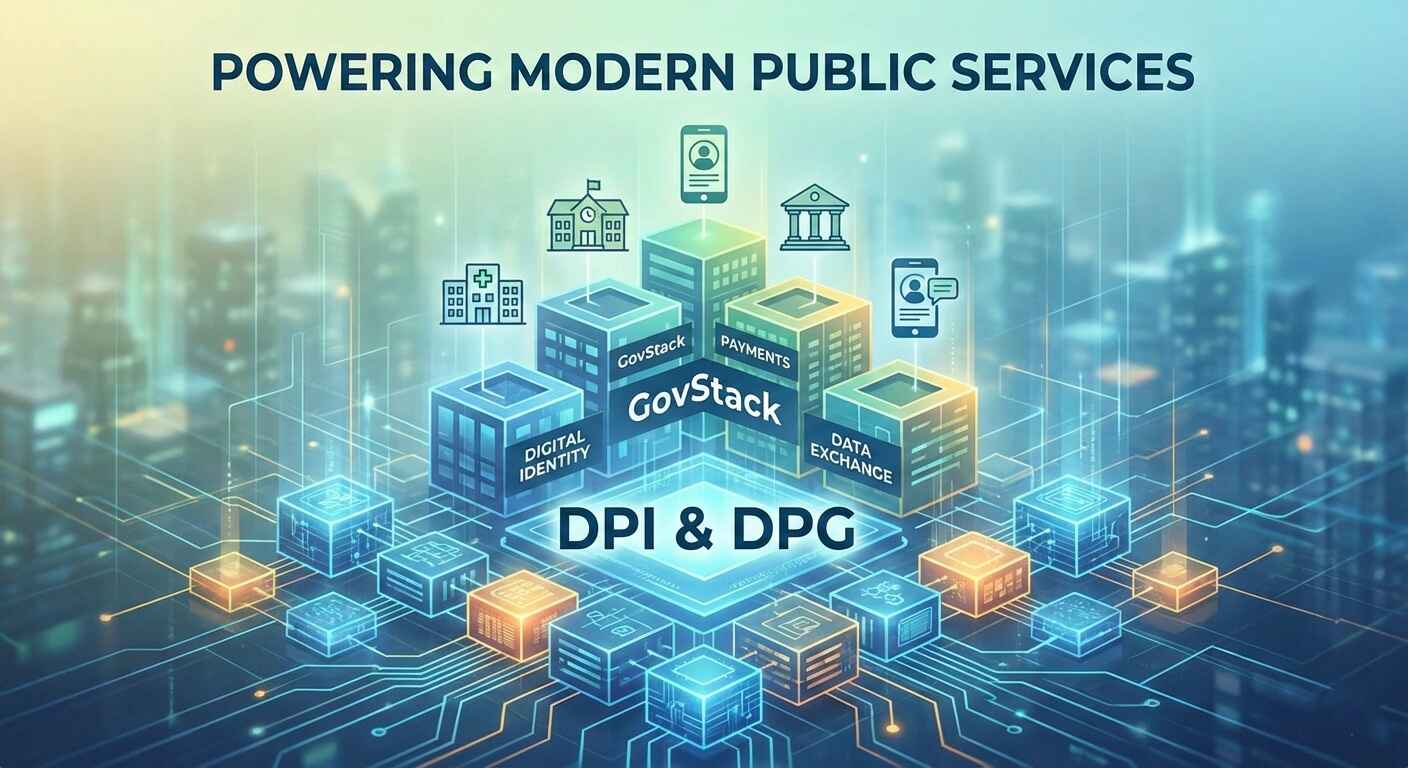
From online IDs to instant payments, modern public services rely on strong digital foundations. Solutions like DPI, DPGs and the GovStack model are now defining how governments build those foundations. According to the OECD, 73% of countries surveyed have implemented a digital identity system as a key component of digital public infrastructure.
Digital Public Infrastructure (DPI), Digital Public Goods (DPGs) and GovStack are transforming how governments build open, citizen-centric services faster, more affordably and at national scale. DPI acts as the backbone of digital society, providing foundational capabilities like identity, payments and data exchange that public and private sectors can build on. DPGs, such as MOSIP, supply the open-source software, standards and frameworks enabling interoperable and cost-effective solutions. GovStack brings these elements together, helping governments reuse proven digital components rather than reinventing systems from scratch.
In this blog, we will explain how these solutions make public services easier to deliver, simpler to innovate on and truly accessible to every citizen.
What Are DPI and DPG?
Digital Public Infrastructure (DPI)
DPI is a secure, interoperable network of shared digital systems that governments (and others) use for identity, payments, data exchange, registries and information systems. It enables secure and seamless interactions between people, businesses and governments, from verifying identity to opening bank accounts.
Core DPI elements include: digital identity systems (unique ID for each citizen), digital payment networks (instant money transfers), data exchange layers (shared databases or APIs) and registries (authoritative lists of citizens, land, health records, etc.).
Digital Public Goods (DPG)
DPGs are open-source software, data sets, and standards designed to improve public services while advancing the UN Sustainable Development Goals. Because they are openly licensed and free to use, governments and organizations can adopt and adapt them without vendor lock-in.
Many DPGs power core Digital Public Infrastructure functions. For example, MOSIP helps countries implement secure and scalable digital identity systems. While not every DPG is a DPI component, some focus on areas like education or climate action, they all serve a public purpose. Those that directly support identity, data exchange, or payments are often described as “building blocks” for national digital systems.
This is where GovStack plays a strategic role. By aligning with the Digital Public Goods Alliance (DPGA) standards, GovStack guides countries in selecting, integrating and evolving DPGs as part of their national DPI. It helps in ensuring interoperability and accelerating digital transformation at scale.
How GovStack Builds DPI
GovStack provides a collaborative blueprint for governments to design and scale digital services efficiently. It offers modular, reusable software components that deliver essential government functions such as identity verification, payments, or data exchange.
Instead of writing software itself, GovStack publishes open specifications and functional requirements for each block, along with compliance testing and standards. Any solution, open-source or proprietary, can be used as long as it meets these specifications.
This flexibility allows governments to assemble their DPI stack from proven solutions. For instance, a GovStack-compliant identity block might rely on MOSIP (or a different platform) to securely verify citizens. By reusing globally trusted frameworks rather than starting from scratch, governments reduce cost, accelerate delivery and ensure interoperability across systems and vendors.
GovStack’s approach is guided by international best practices through a global community of public agencies and development partners. Countries such as Estonia, India and Singapore contribute lessons from their digital transformation leadership, while the GovTest sandbox environment enables testing and demonstration of building blocks in real-world scenarios.
Importantly, GovStack aligns closely with the Digital Public Goods Alliance (DPGA). It helps governments adopt, deploy and evolve certified Digital Public Goods as core elements of national digital infrastructure. In practice, that means a GovStack-based DPI is designed to integrate open, widely adopted solutions rather than reinventing new systems each time.
Together, these elements make GovStack a powerful enabler of scalable, secure and future-ready digital governance.
GovStack Products: Key Functions and the Problems It Solves for Citizens and Governments
| Product Group | Function | Problem It Solves |
| Digital Identity & Registration (Identity BB + Registration BB + e-KYC BB) | Provides secure digital identity, authentication, enrolment and verification for citizens and entities. | Removes duplicate records; reduces identity fraud; simplifies onboarding across all government services.
Eg: MOSIP based systems are used in countries like Philippines, Ethiopia, Morocco, Uganda, Togo, etc. |
| Interoperability & Data Exchange (Information Mediator BB + API Gateway/Data Exchange BB) | Enables secure, standardized communication between government systems using APIs. | Eliminates data silos; reduces integration cost; ensures systems work together reliably.
Eg: X-Road in Estonia connects multiple government databases so that various agencies can securely exchange data |
| Digital Payments & Social Benefits (Payments BB + Social Protection/OpenG2P BB) | Manages digital payments, collections and welfare disbursements. | Fixes fragmented payment processes; reduces leakages in welfare programs; improves transparency.
Eg: In Zambia, OpenG2P is being adopted to streamline government-to-person (G2P) payments for communities affected by drought, helping ensure more accountable delivery of social support. |
| Notifications & Citizen Communication (Messaging BB + Content Management BB) | Sends SMS, email, app alerts and manages content delivery. | Ensures timely updates; improves engagement; reduces service drop-offs. |
| Process Automation (Workflow BB + Scheduler BB + Case Management BB) | Automates service workflows, background tasks and case tracking. | Cuts manual delays; improves efficiency; ensures consistent service delivery. |
| Digital Trust Services (Consent BB + Digital Signature BB + e-Seal BB) | Provides consent management, digital signatures and document authentication. | Builds citizen trust; ensures compliance; reduces paperwork and fraud. |
| Civil Registration (CRVS BB) | Records vital events like births, deaths and marriages. | Modernizes civil registries; improves accuracy of population data.
Eg: OpenCRVS has already improved birth registration outcomes in several regions. In Bangladesh, a 2020 pilot using OpenCRVS helped increase birth registrations by 49%, |
| Analytics & Insights (Analytics BB) | Offers dashboards and analytical insights. | Enables data-driven decisions; highlights service performance issues |
Core Functions of DPI and DPG
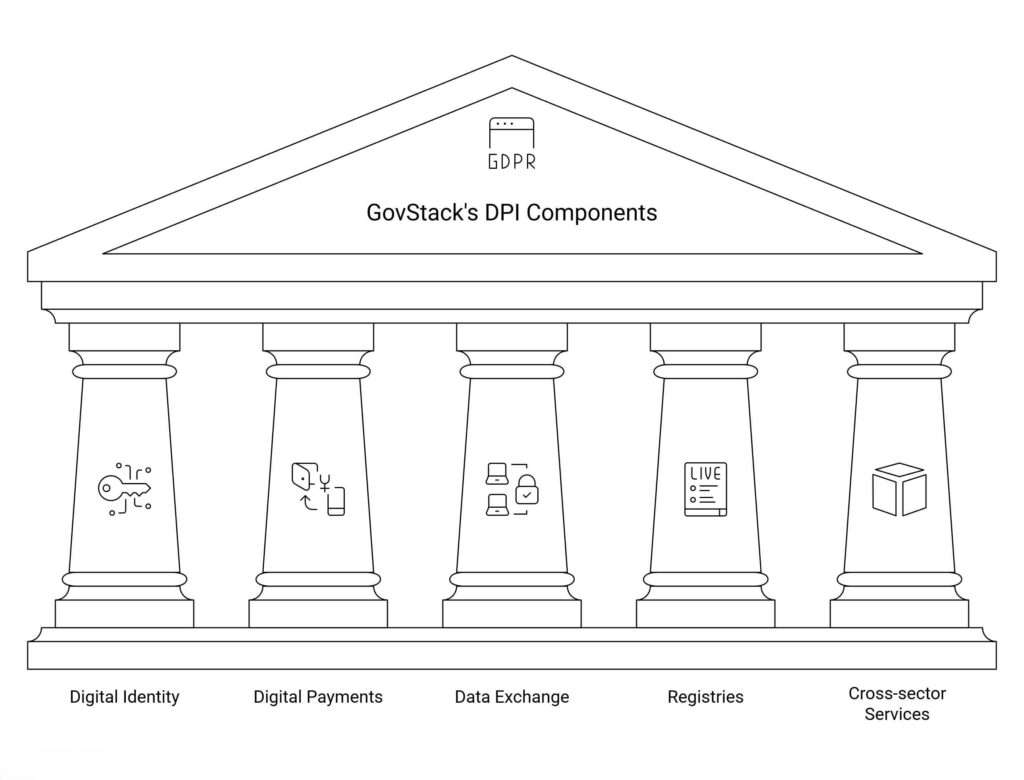
GovStack’s DPI components cover key government functions. By adopting open building blocks, stakeholders can implement these functions consistently. Key functions and example platforms include:
Digital Identity (Citizen ID)
A secure digital identity allows citizens to authenticate themselves when accessing public services, from healthcare and social protection to voter registration.
Open solutions like MOSIP (Modular Open Source Identity Platform) help countries build trusted ID systems affordably. For instance, the Philippines’ national ID system (PhilSys) is powered by MOSIP. As a foundation of DPI, digital ID acts as the gateway to almost every interaction between people and the state.
Digital Payments
Fast, secure money movement between citizens, businesses and government requires interoperable digital payment rails. Open DPGs enable inclusive real-time payments and support financial inclusion and open banking. These platforms allow benefits, taxes, remittances and utility payments to move seamlessly through the economy, reducing friction and boosting access.
Data Exchange & Interoperability
Government systems must communicate securely to provide seamless services. DPGs enable agencies to share data in a trusted and controlled way, so a tax authority can verify business records, or a health ministry can confirm citizen identity. GovStack ensures that information flows only where authorized, reducing duplication and errors.
Registries and Public Records
Authoritative databases, such as population registries, business registries, land records, or health records, are key to efficient service delivery. Open-source examples include OpenCRVS for civil registration of births/deaths and OpenG2P for managing social welfare payments. These ensure governments can record and update life events like birth, marriage and property transfer digitally.
Cross-sector Services
GovStack also covers other public services via modular apps. It provides digital dialogue between businesses, citizens and agencies, which enables things like applying for permits or reporting issues using shared infrastructure.
Together, these DPI components create a digital identity–payment–data pipeline that civil servants, businesses, NGOs and citizens all rely on. Governments use DPI to issue licenses and payments, tech providers build apps on top of the same shared APIs and NGOs can deliver aid using the same digital IDs and payment channels.
Impact on Public Services and Beyond
A GovStack-aligned ecosystem creates a win-win scenario for everyone involved in digital transformation. By reusing proven digital building blocks, each stakeholder gains speed, savings and confidence in what they deploy. It creates advantages across sectors like:
Government Agencies
National and local administrations can launch digital services faster and with less risk. Because GovStack provides pre-defined, interoperable specifications, much of the foundational work is already complete. It allows teams to focus on service delivery rather than infrastructure. Governments also learn from one another: when a solution like MOSIP succeeds in one country, others can adapt it instead of reinventing the wheel.
Technology Providers
Developers and vendors can build innovative products without recreating core functionality like ID, payments, or data exchange. Open standards ensure that any compliant technology, whether open-source or commercial, plugs into the national stack. This expands market opportunities. Health-tech startups, for example, can build apps on top of OpenMRS without designing new medical record systems.
Non-Governmental Organizations (NGOs)
Organizations working in health, education, or humanitarian aid can deliver programs more securely and effectively. Digital IDs and payment rails enable direct cash assistance, verified beneficiary targeting and transparent tracking. NGOs can authenticate students, update citizen records, or link to social registries. These can all be shared through DPI rather than ad-hoc systems.
Enterprises and Fintech
Businesses can reach more people, including underdeveloped communities, through open digital rails. Fintech companies can integrate into a country’s payment network or identity service for instant onboarding. Enterprises in sectors like agriculture or climate tech gain access to trusted data registries that unlock new service models.
In all cases, using DPI/DPG tends to lower costs and boost trust. This collaborative ecosystem, where governments, companies and communities share open code, promotes innovation.
Real-World DPI/DPG Implementations
Across the globe, countries are already proving the value of Digital Public Infrastructure and Digital Public Goods. Established examples include
- Estonia (X-Road): This data exchange platform securely connects government databases and public services. Its success led to X-Road being shared as a Digital Public Good, enabling countries like Finland to reuse the same technology.
- Philippines (PhilSys): In the Philippines, the PhilSys national ID system is being built with MOSIP, showing how a DPG can directly power national-scale identity infrastructure.
- Brazil (Pix): This payment system has similarly become a backbone for the country’s economy, connecting banks, apps and social benefit programs through real-time digital payments.
- India (India Stack): It is a suite of open APIs including Aadhaar (digital ID), UPI (instant payments) and digital consent systems. These rails have unlocked massive financial inclusion: millions of citizens opened bank accounts, businesses can instantly verify identities and digital payments now reach every corner of the economy.
Additionally, momentum is accelerating across Africa as well. Countries like Togo, Nigeria, Senegal and South Africa are adopting modular DPI components, often using open-source tools like MOSIP and mobile-money payment networks. Initiatives such as the global 50-in-5 campaign are helping more than 30 nations rapidly deploy DPI by sharing knowledge and implementation models.
How Technoforte Can Help You
At Technoforte, we bring deep expertise in deploying and integrating open-source building blocks for Digital Public Infrastructure (DPI), enabling governments and organisations to leap-forward their digital service delivery.
MOSIP (Modular Open Source Identity Platform): Technoforte has been a MOSIP Development Partner from the earliest days of the platform. We support everything from project definition, configuration, customised modules, integration with biometric devices and ABIS systems, through to national-scale rollout, device management and support.
OpenG2P: At Technoforte, we provide system integration and custom development for OpenG2P. We tailor the platform to specific benefit-delivery programmes, integrate it with payment systems and legacy infrastructure and deliver pilot and full rollout services.
OpenCRVS: Technoforte has experience integrating OpenCRVS with MOSIP in national ID and civil-registry modernisation projects. In Uganda, we helped migrate 30 million legacy records and set up mobile registration units in rural regions.
With over 20 years in enterprise solutions, we offer mature processes and certified expertise in identity, payments and registry platforms. Additionally, we support large-scale identifier rollout, legacy data migration, remote and offline enrolment, and more, ensuring the DPI stack works everywhere, including rural areas.
Conclusion
Digital Public Infrastructure (DPI) and Digital Public Goods (DPGs) are rapidly becoming the foundation of modern governance. By adopting open, interoperable and reusable digital building blocks, governments can bypass outdated systems and create citizen services that are more inclusive, scalable and secure. Frameworks like GovStack support this transformation by providing ready-to-use architectural blueprints, so countries don’t have to reinvent the wheel.
With increasing investment and international collaboration, governments, technology providers, NGOs, and businesses are all positioned to benefit from more connected and efficient service delivery. Ultimately, embracing DPI and DPGs isn’t just a tech upgrade. It’s a commitment to building public services that truly reach people.
Connect with Technoforte today to accelerate your journey toward secure, scalable and citizen-centric digital transformation.
Email: sanjay@technoforte.co.in, subrat.kumar@technoforte.co.in