Medical imaging is at the heart of modern clinical diagnostics, from X-rays and CT scans to MRIs and pathology slides. These imaging modalities enable clinicians to detect disease, assess severity and make informed treatment decisions. But as the volume and complexity of imaging data continue to grow, relying solely on manual interpretation is becoming increasingly unsustainable.
This is where AI and image analytics come in. By harnessing advanced machine learning and computer vision techniques, AI systems can rapidly analyze vast numbers of medical images, extracting patterns and insights with speed, consistency and precision that traditional methods struggle to match.
In fact, more than 61% of radiologists currently use AI tools to support image interpretation. Today, AI is transforming medical diagnostics by enhancing accuracy, accelerating diagnosis, and reducing human error. In this blog, we will look into how AI-powered image analytics has become a core pillar of healthcare innovation, helping medical professionals scale diagnostic workflows and improve patient outcomes.
What Is AI and Image Analytics in Medical Diagnostics?
What Is AI and Image Analytics in Medical Diagnostics
Artificial intelligence (AI) refers to computer systems designed to perform tasks that typically require human intelligence, such as pattern recognition, analysis and decision-making. Within AI, machine learning allows systems to learn from large datasets, while deep learning uses neural networks to identify complex patterns at scale. This makes it especially powerful for medical imaging applications.
Image analytics in healthcare applies these AI techniques directly to medical images. By examining pixel-level data, algorithms can detect abnormalities, recognize disease patterns and identify subtle structural changes that may be difficult for the human eye to consistently detect.
Medical imaging AI works by converting visual data from X-rays, MRIs, CT scans, ultrasounds, and pathology slides into numerical representations. These data points are then analyzed to classify conditions, detect anomalies, or segment regions of clinical interest, supporting faster, more reliable and more standardized diagnostic decisions.
How AI Analyzes Medical Images
AI-driven medical image analysis follows a structured, multi-stage process that transforms raw imaging data into clinically meaningful insights. Each step is designed to improve accuracy, consistency and diagnostic confidence across healthcare settings.
Data Collection and Training
AI systems are trained on large volumes of labeled medical images, where scans are annotated by radiologists, pathologists and other clinical experts. These datasets span a broad range of diseases, patient demographics, imaging devices and real-world clinical environments.
High-quality, diverse training data is critical for reliable healthcare image analysis, directly influencing model accuracy, robustness and real-world performance.
Pattern Recognition and Feature Extraction
Using deep learning techniques, AI models analyze images at the pixel level to identify features such as texture, shape, contrast and spatial relationships. These features allow algorithms to recognize abnormalities that may be subtle, early-stage or difficult to detect consistently through visual inspection alone.
In many cases, AI image recognition in healthcare uncovers early disease indicators that can be overlooked during routine manual review.
Continuous Learning and Improvement
AI models continue to improve as they are exposed to new data, clinical feedback and validated outcomes. With ongoing learning, systems adapt to evolving imaging standards and patient populations.
Modern deep learning medical imaging platforms are designed to evolve over time, supporting sustained diagnostic accuracy and long-term clinical value.
Key Applications of AI in Medical Imaging
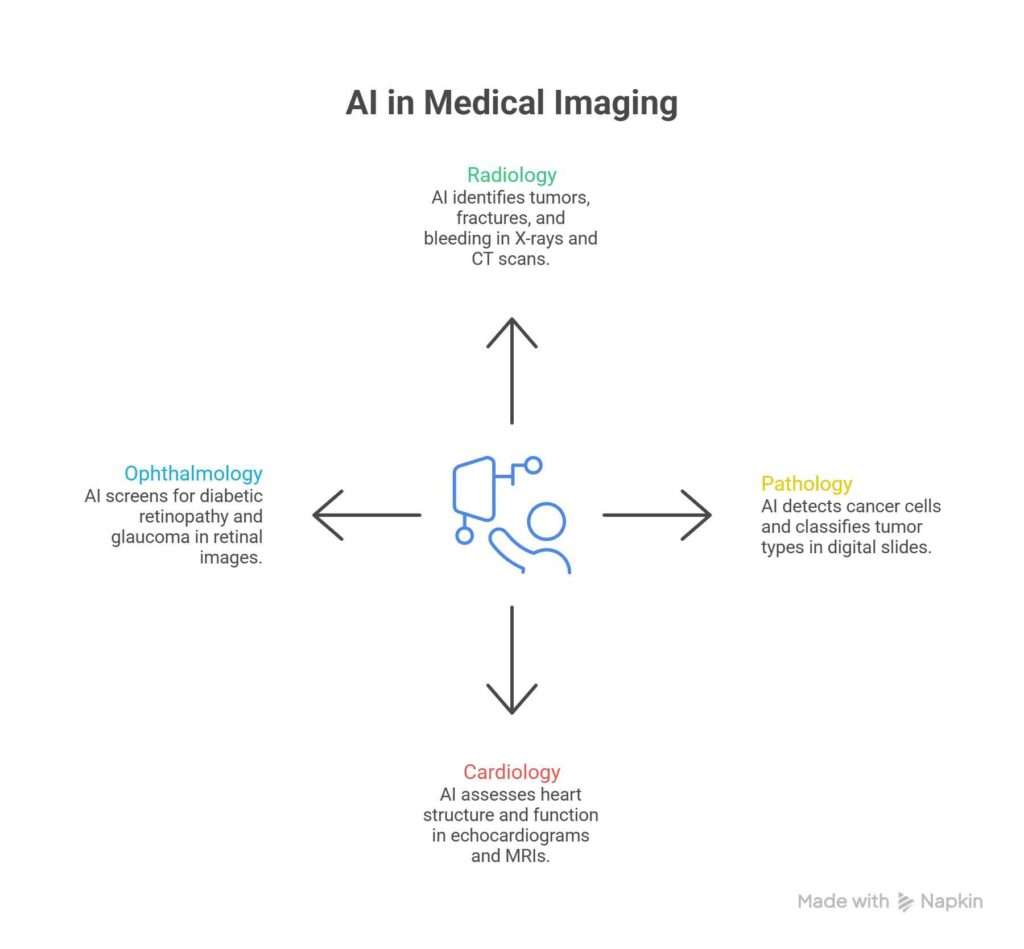
AI-powered image analytics is already being deployed across multiple medical specialties, helping clinicians manage rising imaging volumes while improving diagnostic precision. From early disease detection to workflow automation, these applications demonstrate how AI is reshaping imaging-driven care.
Radiology
AI radiology solutions analyze X-rays, CT scans and MRIs to identify tumors, fractures, internal bleeding and lung abnormalities with high speed and consistency. Automated triage systems flag urgent cases, enabling radiologists to prioritize critical findings and reduce reporting delays.
By enhancing throughput and minimizing variability, AI in radiology supports more efficient and standardized imaging workflows.
Pathology
In pathology, AI platforms enable advanced digital pathology by analyzing high-resolution slide images. Algorithms assist in detecting cancer cells, classifying tumor types and supporting biopsy grading with greater consistency.
Automated image analysis reduces review time while improving reproducibility across pathology assessments.
Cardiology
AI in cardiology leverages echocardiograms, cardiac CT and MRI scans to assess heart structure and function. Algorithms automate measurements, detect structural abnormalities and support risk stratification for cardiovascular disease.
AI-driven cardiac imaging reduces manual measurement variability and enhances clinical confidence in cardiac evaluations.
Ophthalmology
AI ophthalmology tools analyze retinal images to detect conditions such as diabetic retinopathy, glaucoma and age-related macular degeneration. Early, automated screening enables timely intervention before irreversible vision loss occurs.
These AI-powered eye diagnostics are especially effective for population-scale screening programs, improving access to preventive eye care.
Benefits of AI and Image Analytics in Medical Diagnostics
AI and image analytics are delivering measurable improvements across the diagnostic workflow. By augmenting human expertise with data-driven insights, these technologies enhance accuracy, speed and consistency while enabling healthcare systems to scale diagnostic services efficiently.
Accuracy and Early Detection
AI systems excel at identifying subtle patterns and early disease markers that may be difficult to detect through manual image review. Earlier diagnosis enables timely intervention, improves treatment outcomes and helps prevent disease progression. This is particularly in fields like oncology, cardiology and ophthalmology.
Workflow Efficiency
Automated image analysis, triage and prioritization significantly reduce reporting delays. By handling routine screening tasks, AI allows radiologists and clinicians to focus on complex cases, improving overall productivity and reducing diagnostic backlogs.
Reduced Diagnostic Variability
AI provides standardized image interpretation across different clinicians, institutions and imaging environments. This consistency minimizes human subjectivity, reduces inter-observer variability and supports more reliable diagnostic decisions.
Scalability and Cost Efficiency
AI-powered image analytics platforms can be deployed across hospitals, diagnostic labs and large-scale screening programs without proportional increases in staffing. This scalability improves cost efficiency, reduces repeat scans and enables under-resourced healthcare systems to access advanced diagnostic capabilities.
Challenges and Limitations of AI in Medical Imaging
While AI and image analytics offer significant clinical benefits, their adoption in medical imaging is not without challenges. Addressing these limitations is essential to ensure safe, ethical and effective deployment across healthcare systems.
Data Privacy and Security
Medical images contain highly sensitive patient information, making data privacy and cybersecurity a top concern. AI systems require access to large imaging datasets, which increases the risk of data breaches if governance, encryption and access controls are inadequate. Compliance with healthcare data protection regulations is critical for maintaining patient trust.
Bias and Data Representativeness
AI models are only as reliable as the data they are trained on. Limited, skewed, or non-representative datasets can introduce bias, leading to reduced diagnostic accuracy for certain populations. Ensuring demographic diversity across training data is essential for achieving equitable and fair diagnostic outcomes.
Regulatory and Validation Challenges
Before clinical deployment, AI-based diagnostic tools must undergo rigorous validation and regulatory approval to demonstrate safety, accuracy and clinical effectiveness. These processes can be time-consuming and vary across regions, creating barriers to widespread adoption and standardization.
Lack of Transparency and Explainability
Many advanced AI models, particularly deep learning systems, operate as “black boxes,” making it difficult for clinicians to understand how conclusions are reached. This lack of transparency can hinder clinical trust and limit adoption, especially in high-stakes diagnostic decisions where explainability is crucial.
Data Quality and Model Reliability
High-quality imaging data is fundamental to AI performance. Poor image resolution, inconsistent labeling, or imaging artifacts can significantly degrade diagnostic accuracy. Continuous monitoring and quality control are necessary to ensure reliable performance in real-world clinical environments.
Ethical and Regulatory Considerations
The responsible use of AI in medical diagnostics depends on strong ethical foundations, including patient consent, data ownership and transparency in how AI systems operate. When AI tools support or influence clinical decisions, clear accountability frameworks are essential to define responsibility among developers, healthcare providers and institutions.
Regulatory oversight plays a critical role in ensuring that medical AI solutions are safe, reliable and clinically effective. Global authorities such as the U.S. Food and Drug Administration (FDA) and CE regulatory bodies establish approval pathways and performance requirements for AI-based diagnostic tools before they can be deployed in clinical settings.
As medical AI technologies continue to evolve, regulatory frameworks are adapting to keep pace with innovation. Ongoing compliance with healthcare standards, ethical guidelines and validation requirements remains essential for building clinical trust and enabling large-scale adoption of AI in medical imaging.
How Technoforte Can Help
At Technoforte, we have expertise in AI, machine learning and data engineering to build intelligent solutions for data-intensive industries, including healthcare. In the medical diagnostics space, we design and deploy advanced image analytics platforms that run on scalable, cloud-ready architectures, enabling faster clinical workflows and actionable predictive insights.
We integrate our AI solutions seamlessly with existing enterprise healthcare systems, ensuring adoption without disrupting current infrastructure or clinical operations. Our strong focus on data governance, security and regulatory compliance enables the safe, responsible deployment of AI technologies in highly regulated healthcare environments.
Conclusion
AI and image analytics are fundamentally transforming medical diagnostics across radiology, pathology, cardiology and ophthalmology. By enhancing diagnostic accuracy, accelerating decision-making and enabling earlier disease detection, these technologies are helping healthcare providers deliver faster, more reliable and more patient-centric care.
As healthcare systems continue to generate growing volumes of imaging data, AI-driven diagnostics will play an increasingly vital role in improving operational efficiency and clinical outcomes.
At Technoforte, we partner with healthcare organizations to design and deploy scalable, secure and compliant AI-powered imaging solutions. Connect with us today to explore how intelligent image analytics can strengthen your diagnostic workflows and elevate the quality of care across your organization.
Email: sanjay@technoforte.co.in, suresh@technoforte.co.in